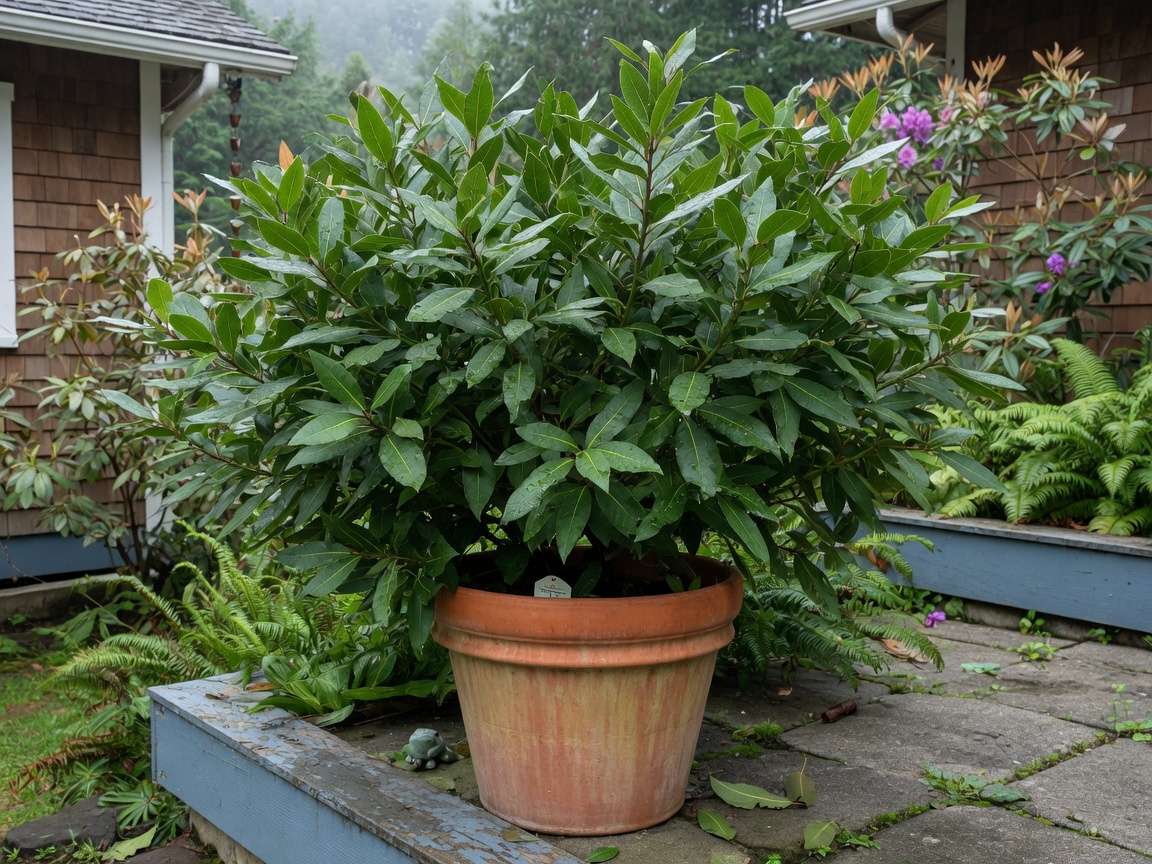
Field notes
- Saucers full of winter rain are not reservoirs—they are anaerobic root chambers.
- California bay is a different chemistry. Do not improvise identity in soup.
- One plant yields more leaves than most kitchens need. Defoliating a juvenile plant for one roast is how you own a stick.
- Late high-N pushes soft growth into frost windows. That is operator error.
- Exposed pots in arctic outflows freeze roots first. Move three feet or accept the outcome.
Learning objectives & crop biology
Evergreen Mediterranean tree/shrub used for aromatic leaves. In North Bend, treat as borderline hardy: large containers with winter shelter, or highly protected south courtyards with drainage. Not a lawn island. Not a dark north patio “because the table looked good there.”
Failure mode
Bay is slow. Impatience produces overpotting, overfeeding, and overharvest. None of those accelerate lignified canopy—they just stress it.
Irradiance
6+ h sun to light afternoon shade. Deep shade yields sparse leaves with little culinary impact.
Lab note: Year-round deep shade “for winter protection” is just shade with better PR.
Edaphic requirements
Well-drained potting mix with mineral grit; near-neutral pH. In-ground only with excellent drainage and cold-air drainage. Winter sumps fail.
Irrigation protocol
Water when top 2–5 cm dry—often 1–3× weekly in summer containers; far less in cool rain. Full soak, free drain, empty saucers. Overwater → chlorosis/rot; underwater → marginal necrosis. Extremes are not a personality—they are bad control systems.
Lab note: “When I remember” is not an irrigation protocol. Instrument it or own the symptoms.
Nutrient management
Moderate. Slow-release spring feed; light midsummer if growth stalls. Avoid late-season N that delays hardening.
Phenology — North Bend
- Acquire/plant in frost-free windows; spring preferred.
- Relocate containers before hard freezes and prolonged arctic outflow.
- Harvest mature leaves as needed year-round once canopy allows.
Advanced practice: pot size & leaf quality
Start ~5 gal; graduate to 15–20+ gal. Root-prune/repot when bound. Mature leaves carry classic flavor; young leaves milder. Dry for storage density.
Graduate extension: cold protection
Insulate pots (roots freeze before canopy), group on south walls, frost cloth on clear cold nights, no fall N benders. Mortality is usually wet-cold roots—not insufficient classical music.
Biotic stress
Scale, aphids, sooty mold, root rot. Inspect abaxial leaf surfaces. Oil sprays when labeled and timed. Ignoring scale until sticky is a choice.
Harvest
Take older leaves; preserve apical growth on small plants. Dry flat in shade. Remove whole leaves from cooked dishes before service—aspiration hazard is not a joke question on the final.
Unit close
Identify true bay · drain the pot · sun it · shelter it · harvest moderately. Jar dust is the control treatment if you will not do the work.