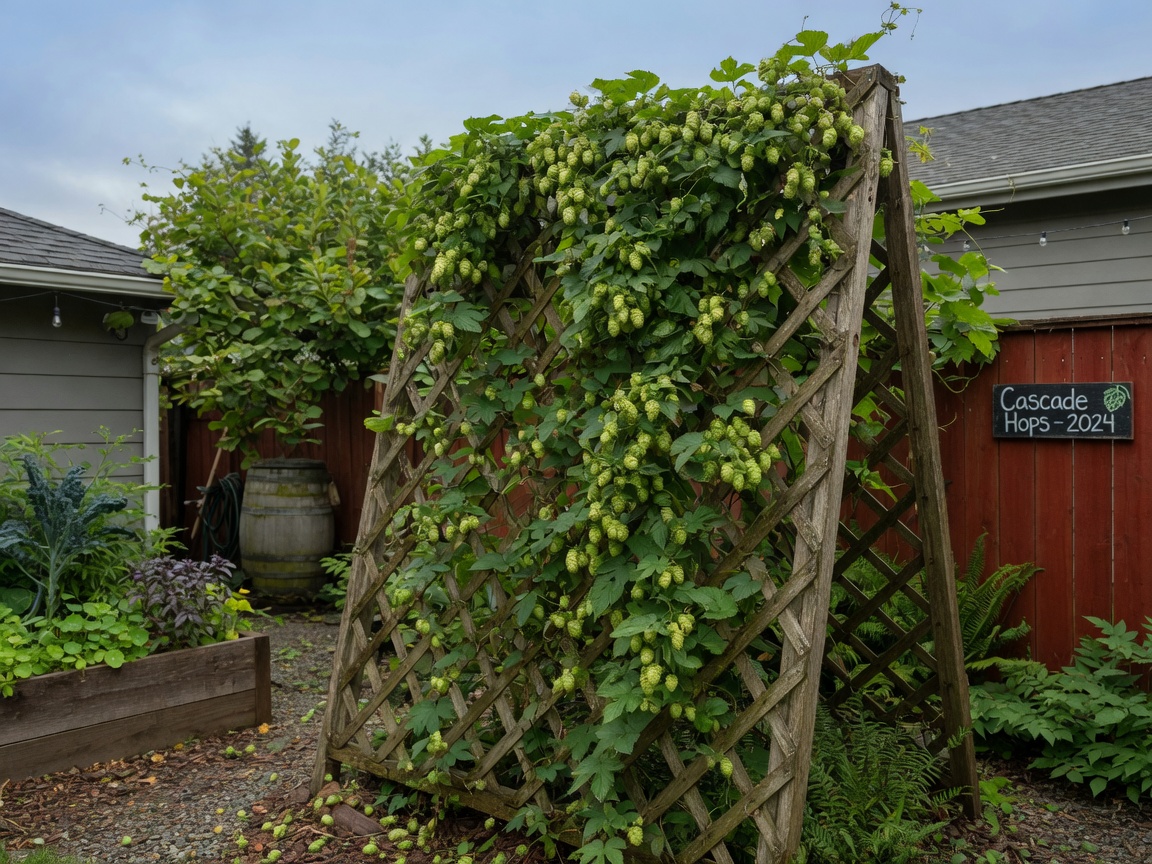
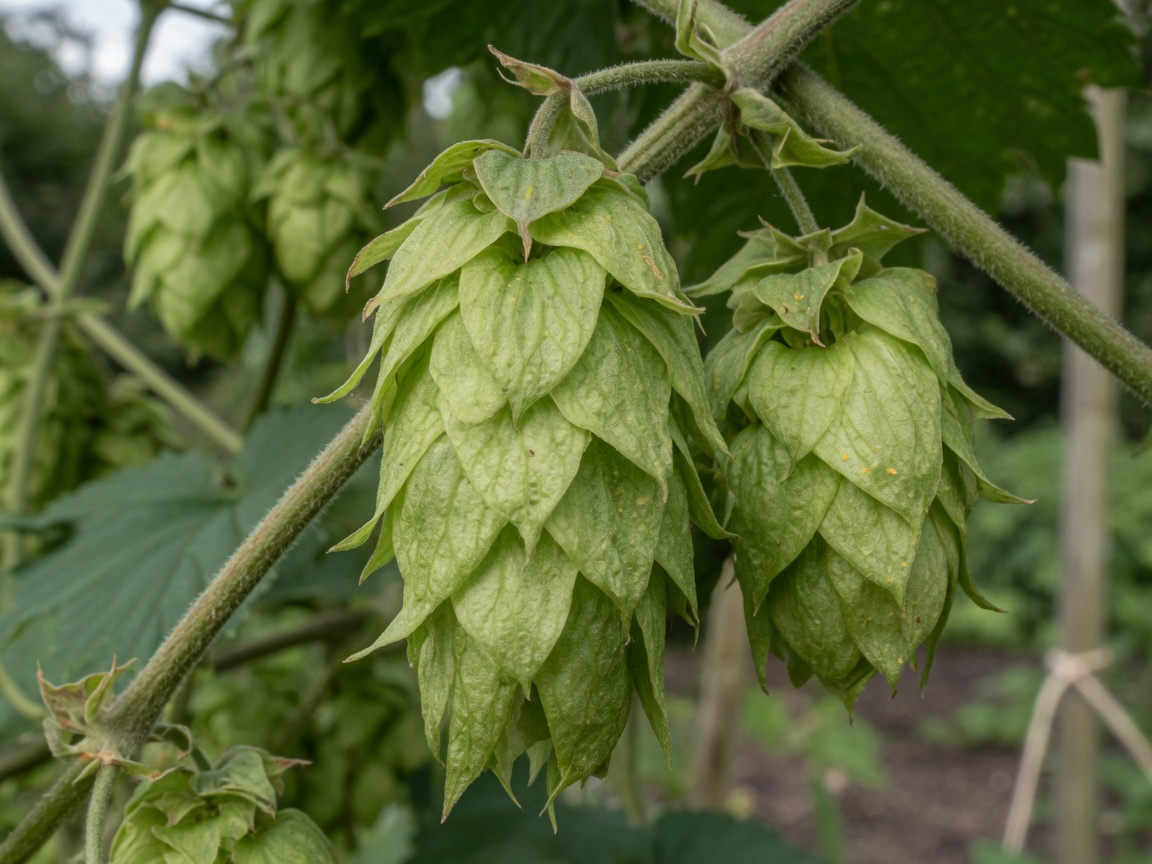
Field notes
- Tomato cages as hop supports are category errors. The bine will grade your engineering in public.
- Year-1 sparse cone sets are establishment biology. Panic N loading will not summon a commercial yard.
- North-wall plantings trade yield for mildew pressure. Full sun is the assignment.
- Unthinned bine jungles reduce cone efficiency and airflow. Select 2–4 leaders per string.
- Skipping postharvest dry-down converts aroma chemistry into compost. Process promptly.
Learning objectives & crop biology
Galaxy is valued for tropical/passionfruit aromatic notes in brewing. Commercial systems use female plants for cone production—source rhizomes/crowns from reputable suppliers. Perennial crowns, vigorous bines, deep roots: require tall support (often 10–20 ft / 3–6 m), full sun, and midseason water. Westside backyard success is real under correct installation.
Failure mode
Collapsed trellises midseason are structural failures, not cultivar failures. The plant simply applied load you refused to design for.
Irradiance
≥8 h full sun. Shade reduces yield and elevates mildew risk. South/west preferred.
Lab note: Cultivar origin (Australia) is not a substitute for photons. Enthusiasm is not a light source.
Edaphic requirements
Deep, fertile, drained loam; high OM; pH roughly 6.0–7.5. High water and nutrient demand with zero tolerance for permanent stagnation. Berms on heavy sites. Wide root zone—not windowsill cosplay.
Irrigation protocol
Peak demand during bine run and cone fill. Dry summers: deep irrigation 1–3× weekly by soil and heat. Keep root zone moist, not anaerobic. Year 1 establishment requires consistency. Drought stress midseason is not “toughening.”
Lab note: High annual rainfall still fails August root zones. Seasonal distribution matters more than yearly totals. Probe soil.
Nutrient management
High demand. Compost pre-plant; spring N as bines accelerate; balanced midseason nutrition. Front-load fertility with growth; excess late N softens tissue. Containers (suboptimal long-term) need volume and frequent feeding—or plant in ground like you own soil.
Phenology — North Bend
- Plant rhizomes spring when soil workable.
- Train selected bines up strings early; missed windows become ground-level chaos.
- Harvest late summer by cone feel/aroma/dry-matter cues.
- Cut bines after senescence; compost only disease-free material.
Advanced practice: training, disease, postharvest
Select 2–4 strong bines per string; remove extras. Manage downy/powdery mildew via airflow, morning sun, sanitation. Dry cones with airflow until bracts brittle/strig snaps; store cold, oxygen-limited. Year 1 = roots; years 2–3 = production. Rhizomes spread—contain if property lines matter.
Graduate extension: year-1 expectations
Modest cones are normal. Do not rage-fertilize. Do not claim the cultivar “fails in Washington” after four hours of sun and a broomstick trellis. Installation quality is a graded variable.
Biotic stress
Aphids, spider mites in hot dry spells, mildews, structural failure, deer on young shoots. Harvest gloves recommended—bines are mechanically hostile.
Harvest & processing
Squeeze test: spring-back, yellow-gold lupulin, strong aroma. Dry immediately. Wet bag storage invents unwanted biota. Brewing optional; rot is the default if you stall.
Unit close
Engineered verticals · full sun · rich drained soil · midseason water · train/thin · dry cones. Anything less is a 15-foot tangle with three sad cones and a story.