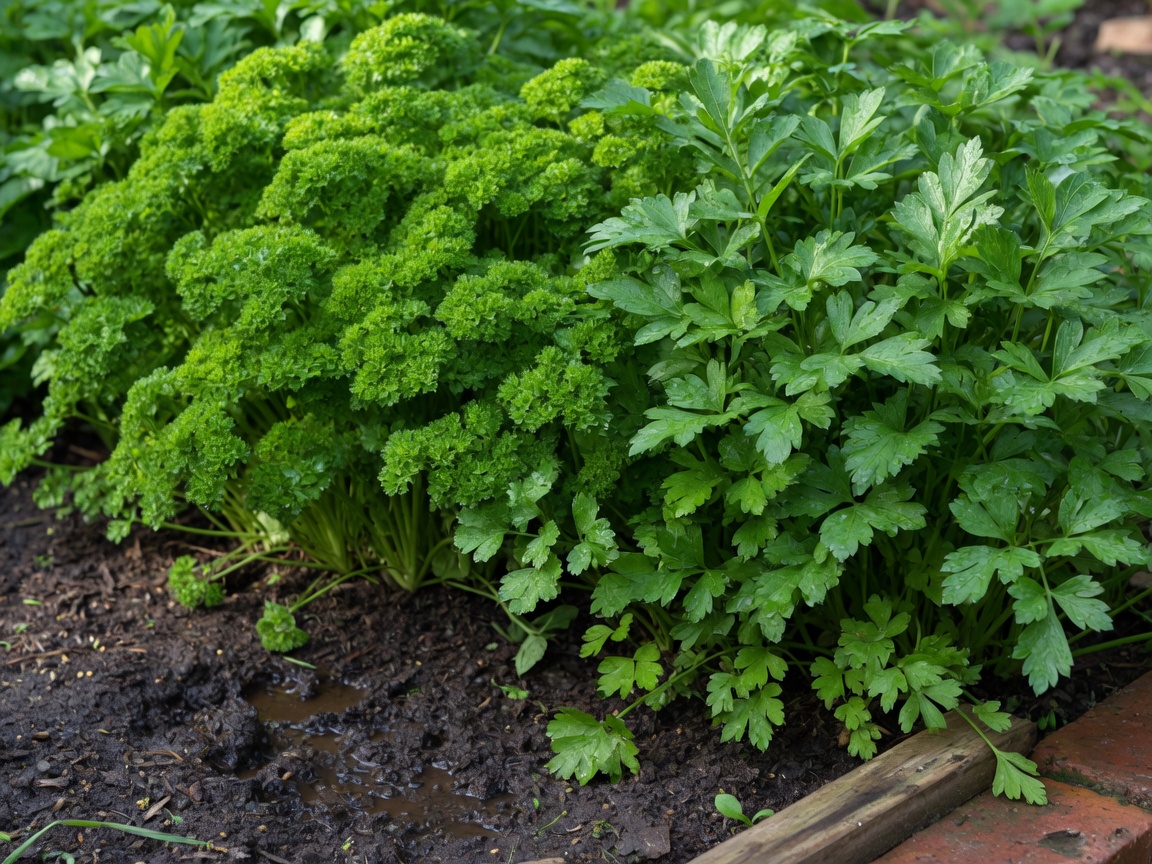
Field notes
- Abandoning seed at day 10 is a patience failure. Expect 14–28 days. Time is part of the protocol.
- Stripping the apical center for one garnish event destroys the plant’s future leaf production.
- Drought-proof Mediterranean herb culture kills parsley. Different guilds, different water.
- Year-2 flowering is biennial biology, not a broken cultivar.
- One plant by the grill is not an herb system. It is a hostage.
Learning objectives & crop biology
Year 1: vegetative leaf production. Year 2: reproductive bolting and seed. Grown primarily as an annual leaf crop. Flat-leaf generally superior for cooking; curly holds structure. Taproot benefits from deep media in containers.
Failure mode
If your only parsley is restaurant confetti, you have not run the module. If you grow a clump and then forget it in the fridge, you have completed half the postharvest unit—poorly.
Irradiance
4–6+ h; full sun to part shade. Afternoon shade in heat preserves leaf quality. Deep shade produces thin, low-yield canopies.
Lab note: Parsley is more shade-tolerant than lavender. That still excludes the crawlspace under the deck.
Edaphic requirements
Rich, moist, drained, high OM; pH ~6.0–7.0. Fertility and water demand diverge sharply from Mediterranean woody herbs—do not force a polyculture that fights itself.
Irrigation protocol
Even moisture. Dry weather: 2–3 irrigations/week in raised beds (~25–40 mm/week). Containers dry fast. Moist ≠ anaerobic swamp—crown rot still grades you.
Lab note: Wilt is not “resting.” Restore soil moisture before permanent damage.
Nutrient management
Moderate–high N for continuous harvest. Compost-rich soil; side-dress every 4–6 weeks in peak season. Pale plants: separate hunger from waterlogging before adding N.
Phenology — North Bend
- Sow/transplant early spring; succession midsummer for fall/winter leaves.
- Germination 14–28 days; optional seed soak is ritual with mixed evidence—do not skip moisture control either way.
- Overwinters often with mulch; spring bolting expected in year 2.
Advanced practice: herbivory & succession
Black swallowtail larvae may defoliate. Share, exclude, or grow sacrificial Apiaceae. Maintain succession so one chewed plant is not the entire dataset.
Graduate extension: winter leaf systems
Cold frames produce high-quality winter parsley. Growth slows; harvest outer petioles; preserve crown. Plan storage if outdoor growth stalls.
Biotic stress
Seedling slugs, aphids, swallowtail larvae, crown rot. Slugs always enroll in this course. Respond with IPM, not surprise.
Harvest & postharvest
Cut outer stems at base. Store as cut stems in water or bagged refrigeration. Dried parsley is inferior but functional emergency inventory.
Unit close
Rich moist soil · patience at germ · succession · outer-stem harvest. Rubber-banded store bunches remain the control if you will not run the protocol.