Field notes
- High N “to make it grow” produces succulent shoots that fire blight exploits. Vegetative excess is not vigor—it is vulnerability.
- Leaving shepherd’s-crook strikes “to see if they recover” is how inoculum stays enrolled in your canopy.
- Many cultivars need a pollen partner. Minimalist single-tree plans often underperform. Biology is not a design aesthetic.
- European pears left to soften on the branch are overripe. That is the lesson.
- Dirty tools between blight cuts vector bacteria. Disinfect. Boring competence wins.
Learning objectives & crop biology
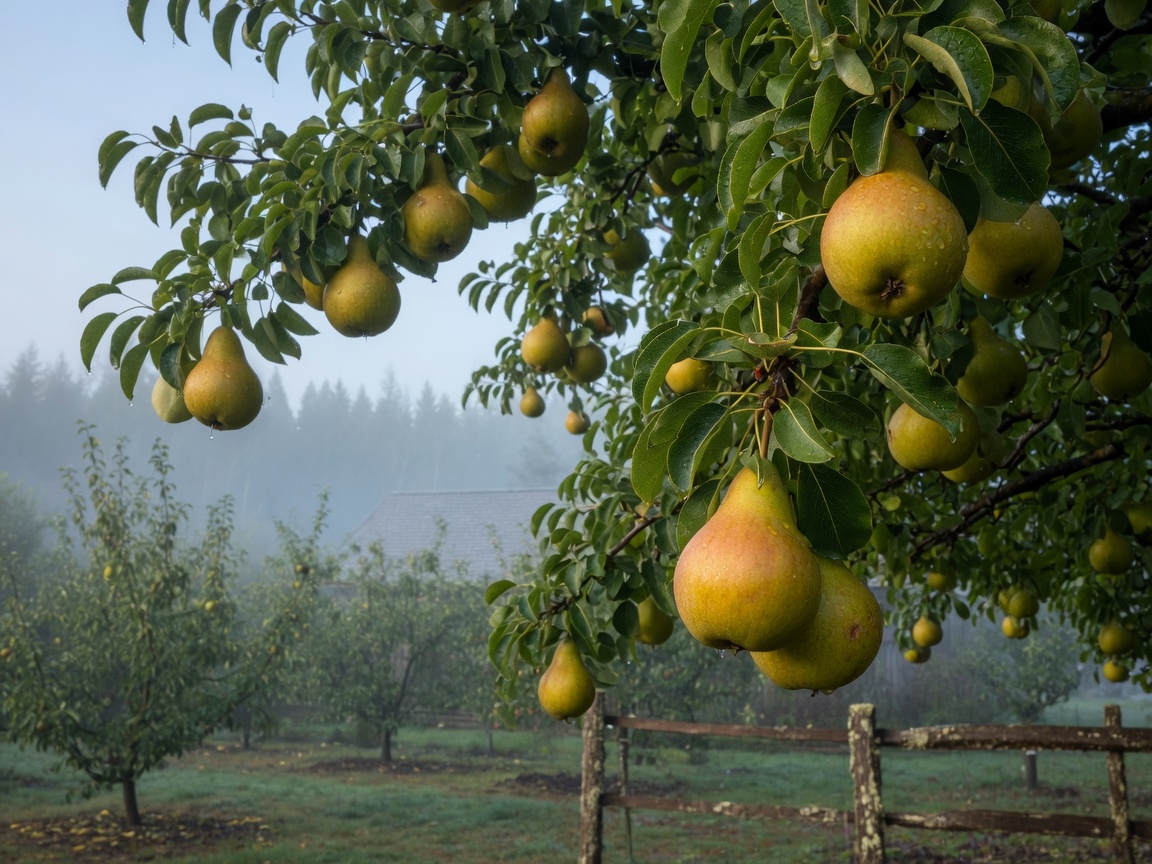
European (P. communis) and Asian (P. pyrifolia) pears require full sun and drainage. They may tolerate heavier soils slightly better than peaches—still not swamp culture. Fire blight is the dominant pathology narrative; choose less-susceptible cultivars when available and prune with sterile technique.
Failure mode
Recurrent blight with high-N soft growth and delayed sanitation is not bad luck. It is a feedback loop you keep funding.
Irradiance
≥8 h full sun. Shade produces vertical watersprout architectures and poor cropping.
Lab note: Fruiting requires light and living wood. Hope is not a third input.
Edaphic requirements
Deep drained loam, pH ~6.0–7.0. Mound on clay. Suppress grass competition in the young root zone.
Irrigation protocol
Young trees: deep weekly soaks in dry months. Mature: drought and fruit-swell irrigations. Moisture oscillation increases drop risk and stress flushes favorable to blight.
Lab note: Drought → panic flood → drought is operator oscillation, not “natural rhythm.”
Nutrient management
Low–moderate. Avoid luxury N. Spring compost; fertilize only on demonstrated weak growth. No late soft pushes into fall.
Phenology — North Bend
- Plant dormant bare-root late winter–early spring.
- Dormant prune; remove blight strikes promptly in dry weather during season (cut well below symptoms).
- European: harvest mature-firm, ripen indoors. Asian: often more tree-ripened—know your taxon.
Advanced practice: blight sanitation & harvest IQ
Symptoms: necrotic shoots, shepherd’s crook. Cut 20–30 cm into healthy wood where feasible; disinfect tools between cuts. Avoid aggressive pruning during warm wet bloom windows. European maturity: lift-twist separation; finish ripening cool indoors.
Graduate extension: pollination charts
Compatible partners with bloom overlap matter. Asian × European compatibility is bloom-time dependent—verify. “Self-fertile” is not a license to ignore pollen ecology.
Biotic stress
Fire blight, scab, psylla (regionally), birds, deer. Cultivar choice and sanitation outrank panic spraying as identity.
Harvest & storage
Handle as bruise-sensitive. Cold store; ripen batches. Overripe fruit is compost with a sticky floor tax.
Unit close
Sun · drainage · low N · blight hygiene · pollen partner · correct harvest maturity. Miss the set and maintain a blighted leaf fountain labeled “experience.”